
AML & PRIVACY | MID-TIER AND LARGER FIRMS
When did your firm last update its privacy policy and collection notice?
If it was before 1 July 2026, they are unlikely to reflect the information your AML/CTF program now collects, or the OAIC's August 2026 guidance for reporting entities. And documents only work if the staff handling client files know how to apply them.

WHAT CHANGED
Privacy is not new to your firm.
Some of this information is.
Firms with turnover above $3 million have been bound by the Australian Privacy Principles for years. National firms with in-house privacy teams may already have reworked their documents for AML/CTF. Many mid-sized firms have not yet had the chance. The lead-up to 1 July went on AML/CTF programs, enrolment and customer due diligence processes.
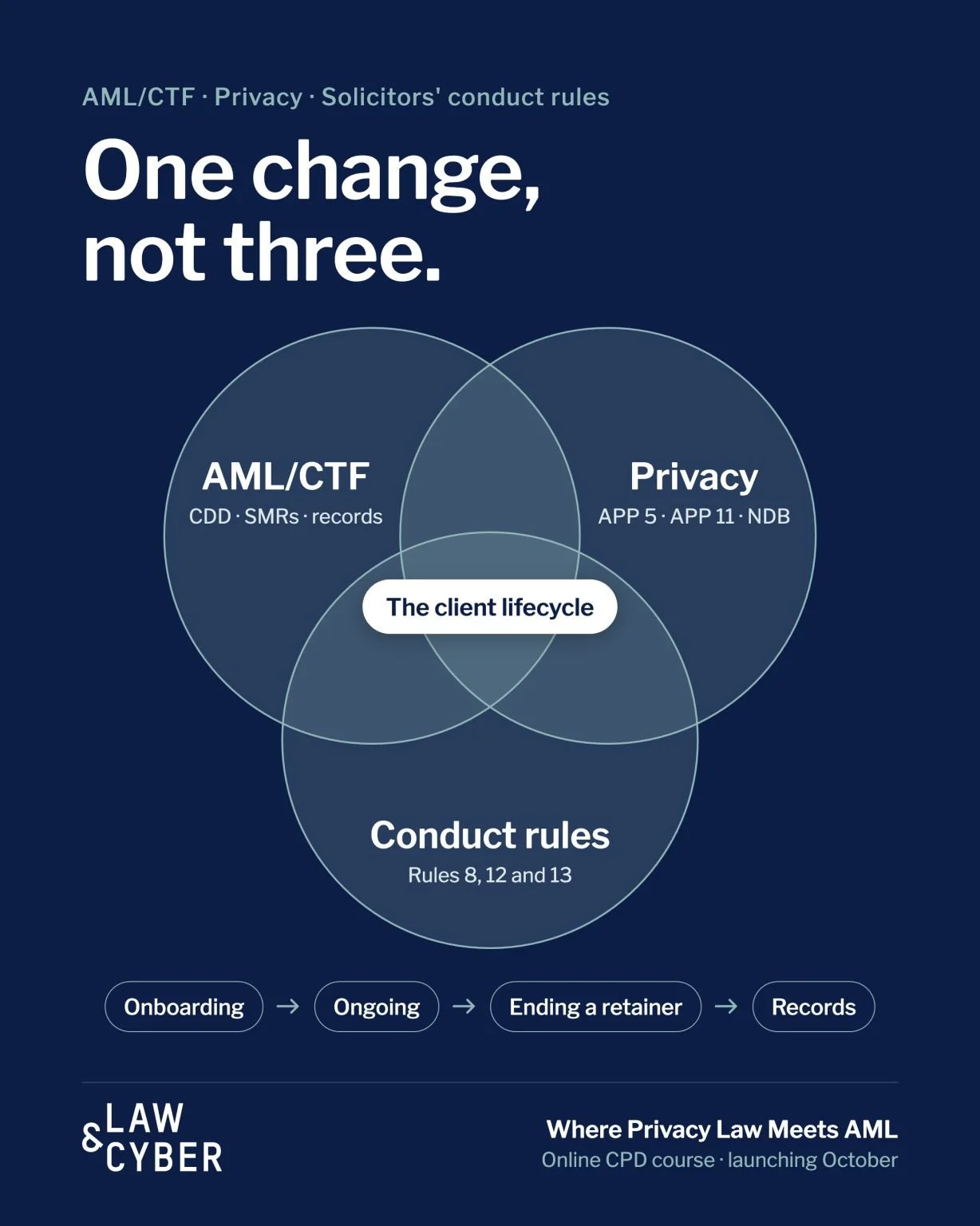
Tranche 2 did not change your privacy status. It changed what your privacy documents now have to govern, and it created points where the two regimes pull in different directions.
Where the risk sits
New information, and a new reason for collecting it. Property firms have verified client identity for years. What is new is beneficial ownership details, source of funds evidence, PEP and sanctions screening results and records linked to suspicious matter reports. The AML/CTF Act now requires much of this collection, and APP 5 requires your collection notice to tell clients that and name the law.
Access requests and tipping off. A client can ask for the personal information you hold. If the file touches a suspicious matter report, the reply has to avoid tipping off, which is a criminal offence.
Retention and destruction. AML/CTF record-keeping sets how long records must be kept. APP 11.2 then requires them to be destroyed or de-identified. Someone has to know which rule applies, and when.
Breach response. A data breach involving identity documents and CDD records is likely to be serious, and has to be assessed and notified on a tight timetable.
The OAIC's August 2026 guidance. Privacy guidance for reporting entities under the AML/CTF Act sets out what the regulator expects. It is the natural benchmark for any document review.
The 2026 conduct rule amendments. Solicitors must now accept, and not merely follow, only lawful, proper and competent instructions, and failure to provide customer due diligence information is now an example of just cause to terminate a retainer. In force in NSW, Victoria, WA and the NT from 1 July 2026 and in Queensland from 25 September 2026.
WHY TRAINING MATTERS
The penalty was for the response, not just the attack
In Australian Information Commissioner v Australian Clinical Labs Limited (No 2) [2025] FCA 1224, the Federal Court ordered the company to pay $5.8 million after a cyberattack. $1.6 million of that related to the response: the company had not properly assessed whether it had an eligible data breach, and had not notified the OAIC as soon as it should have.
In a law firm, the policy is rarely what fails first. It is the staff member who does not recognise a possible breach, or who answers an access request without knowing a suspicious matter report has been lodged. That is true however recently your documents were updated.
THE COURSE
Where Privacy Law Meets AML
This is not AML training, and it does not replace your AML/CTF program. It covers the privacy obligations that attach to AML/CTF information, which most AML training leaves out.
Module 2: On the file (recommended for firms)
About an hour. It opens with a short lesson for firms already covered by the Privacy Act, then follows a property matter in which a settlement pack goes to the wrong client. It covers:
where AML/CTF and privacy obligations conflict, including access requests and tipping off
what staff may say when the firm stops acting and cannot give reasons
what must be kept and what should be destroyed
recognising and notifying an eligible data breach, and payment redirection fraud
the privacy documents a reporting entity needs, and how to check existing ones against the OAIC guidance
for solicitors, the 2026 conduct rule amendments.
Module 1: Foundations (optional)
For intake, support and new staff: core AML/CTF vocabulary, what counts as personal and sensitive information, and what a collection notice must tell clients.
CPD: one point per module for solicitors, excluding Western Australia. A certificate is issued for each module completed.
Other practice areas: the examples are drawn from property and conveyancing work. A version covering all designated services is in development. Register your interest.
FOR PROFESSIONAL BODIES & ASSOCIATIONS
Introductory firm pricing until 30 November 2026
Lock in your price by 30 November and start your 12 months any time before 1 March 2027, in time for the CPD year-end. Commit to two years by 30 November and the second year is half price.
Prices are per learner and exclude GST.
| Learners | Module 2 only | Both modules |
|---|---|---|
| 11 to 49 | $45 | $60 |
| 50 to 99 | $42 | $55 |
| 100 or more | $38 | $50 |
| Whole firm, unlimited learners | $7,450 | $9,950 |
You will never pay more than the price for the minimum number of learners in the next tier.
Training 10 people or fewer? The team pack gives both modules to up to 10 staff for $599 including GST until Friday 30 October, then $699.
How a firm licence works
We agree the number of learners and modules, and invoice your firm.
We send you one enrolment link for your staff. Nothing to install, and no learning management system needed.
Each learner has 12 months' access and receives a certificate for each module they pass.
We can provide completion records for your training register.
Need to run the course through your own learning management system? Ask us about a files licence.
THE TOOLKIT
Privacy documents built for AML/CTF
The AML Privacy Toolkit contains two guides and eight templates drafted for AML/CTF property work: a collection notice, privacy policy, internal staff privacy policy, data handling procedure, data breach response plan, third-party disclosure register, destruction schedule and GDPR privacy notice. Each comes with instructions.
It was written for property practices with annual turnover of $3 million or less that were outside the Privacy Act until their AML/CTF obligations began on 1 July 2026. If your firm was already covered by the Privacy Act, its AML-specific documents may still be useful as a check on your own. Contact us before buying and we will tell you whether it suits your firm.
$350 including GST. It is not included in a firm licence, but can be added.

ABOUT
Who developed it
Simone Herbert-Lowe is the founder of Law & Cyber. She has more than 30 years of legal experience, including 20 years in professional responsibility at Lawcover, where she handled thousands of professional indemnity notifications, and was a partner in Clyde & Co's cyber, media and technology practice.
Common Questions
-
Most AML training covers how to identify and verify clients and when to report. It rarely covers what the Privacy Act requires once that information is held: how it is stored, who can access it, how long it is kept, and what happens when it is breached. This course covers that gap.
-
No. It is an all-staff course on the privacy obligations that attach to AML/CTF information. It does not replace your AML/CTF program, your AML training or the specialist training your AML compliance officer needs.
-
Yes. Documents only work if the people handling client files apply them. Module 2 focuses on the decisions staff make on the file: answering an access request, deciding what to keep and what to destroy, and recognising a possible data breach.
-
The principles apply across designated services, but the examples are drawn from property and conveyancing. A version covering all designated services is in development. Register your interest and we will give you priority access.
-
For most staff in an established firm, Module 2 is enough. Module 1 suits intake and support staff and anyone new to both regimes.
-
Commit to two years by 30 November and the second year is half your first-year price, for the same number of learners. Any extra learners are charged at your tier rate.
-
Yes. Request a preview and we will give you access to a chapter.
-
Firm licences are invoiced. Team packs and individual enrolments are paid by card on our course site.
Talk to us about your firm

Materials are provided for general educational and guidance purposes only and do not constitute legal advice. They reflect the regulatory framework as at the date of publication. Copyright 2026 Law and Cyber Pty Ltd (ABN 68 629 258 377). Liability limited by a scheme approved under Professional Standards Legislation.